What two and a half years of Klarna’s own filings and statements say about the numbers an AI business case has to carry, and the ones it usually leaves out.
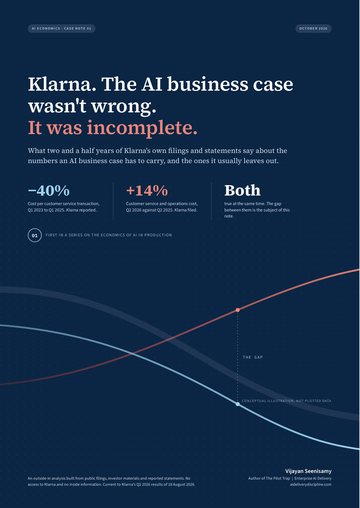
An outside-in analysis built from public filings, investor materials and reported statements. No access to Klarna and no inside information. Current to Klarna’s Q2 2026 results of 18 August 2026.
I’ve sat in enough AI steering meetings to know which number wins the budget. It’s the one that goes down. Klarna is the clearest public example I know of what happens next, and almost everyone tells it wrong. This note is the version you can repeat in a board meeting, built from what Klarna filed and said, with the gaps marked.
About $40m projected at launch in February 2024. About $39m delivered in 2024, per Klarna’s SEC correspondence, a realised figure rather than a projection. $58m annualised in the Q3 2025 investor presentation, $60m on the call. Satisfaction on par with human agents throughout.
from $0.32 in Q1 2023 to $0.19 in Q1 2025. The unit got cheaper.
Customer service and operations cost $53m in Q3 2025 against $44m, $54m in Q1 2026 against $51m, and $58m in Q2 2026 against $51m. By mid-2026 it was growing slower than revenue, 14% against 27%, but it was growing.
In May 2025 the CEO said cost had become too dominant a factor. Coverage read it as a retreat from AI. In July 2025 Klarna told the SEC the remarks concerned a pilot of highly skilled freelance consultants to raise the quality of human service, did not relate to AI quality, and were misreported. It calls the model dual-track.
Klarna’s internal business case isn’t public, so this note judges the case as Klarna presented it. That public case priced the average contact, and the average got cheaper, exactly as promised. What it didn’t have to show was the quality Klarna would stand behind for the customers who aren’t average, the human path to deliver it, and the fact that a bill can shrink per unit and grow in total at the same time, with growth alone enough to produce that combination. None of that invalidates the saving. It changes what a complete AI business case has to carry. The unit has to be the cost of resolving the customer’s problem to the quality the business will stand behind, and cost per contact doesn’t measure that.
Find the number it counts. Then find the number it doesn’t, and decide who in your organisation is going to carry it when it arrives. Download the template, or read it below.
An outside-in analysis of public filings, investor materials and reported statements, current to Klarna’s Q2 2026 results of 18 August 2026. No access to Klarna, no inside information, and no estimates of figures Klarna hasn’t disclosed. The sources section at the end lists every source and every gap.
Eight dated points from Klarna’s own statements, February 2024 to August 2026. Nothing on this page is interpretation.
2.3 million conversations in the first month, two-thirds of all chats. Resolution under two minutes against eleven. Repeat inquiries down 25%. Work equivalent to 700 full-time agents. Projected profit improvement of about $40 million in 2024.
Operating expenses down 11% year on year. Nine in ten employees using AI in daily work. The assistant credited with lower operating costs.
From $0.32 to $0.19 per transaction, Q1 2023 to Q1 2025. Satisfaction reported steady after the rollout. The assistant handling two-thirds of inquiries.
To Bloomberg, Sebastian Siemiatkowski says cost had become too predominant a factor and quality suffered, and describes recruiting skilled remote agents on flexible terms. Forbes and others report it as a retreat from AI in customer service.
In correspondence on its IPO filing, Klarna tells the SEC the assistant handled 66% of chats in the year to March 2025, equivalent to over 700 agents, and delivered about $39 million in savings in 2024, with satisfaction on par with humans. It states the CEO’s remarks concerned a pilot of skilled freelance consultants to raise the quality of human service, did not relate to AI quality, and were misreported. It describes a dual-track model of scalable AI plus high-quality human support.
From this point every quarter’s customer service and operations cost is a filed number.
On the Q3 call the CEO says the assistant now does about 853 full-time jobs, up from 700, with a saving of $60 million, and that it still handles two-thirds of inquiries. The investor presentation puts the annualised estimated saving at $58 million. The same quarter’s filing shows customer service and operations cost of $53 million, up from $44 million a year earlier, with active consumers up 32% to 114 million.
Customer service and operations cost $58 million in Q2 2026, up from $51 million, a 14% rise against revenue growth of 27%. Active consumers 120 million, up 8%. The results release carries no new figure for the assistant’s share of chats.
Dates are publication dates.
The 2024 claims have held or improved on Klarna’s own telling. The gaps are in what was never disclosed.
| Metric | Klarna’s first statement | Latest Klarna figure | Where | Status |
|---|---|---|---|---|
| Share of chats handled by AI | Two-thirds, first month after launch | 66% for the twelve months to March 2025 (SEC). Two-thirds, repeated on the Q3 2025 call. No figure since. | Press release Feb 2024; SEC letter Jul 2025; Q3 2025 call transcript | Held |
| Agent-equivalent workload | 700 full-time agents | Over 700 (SEC, Jul 2025). About 853 (Q3 2025 call and investor presentation). | Press release Feb 2024; SEC letter; Q3 2025 call transcript and presentation | Rose |
| Annual cost saving | About $40m projected profit improvement for 2024 | About $39m delivered in 2024 (SEC). $58m annualised estimate (Q3 2025 investor presentation); $60m stated by the CEO on the call. | Press release Feb 2024; SEC letter; Q3 2025 presentation and call | Rose |
| Resolution time | Under 2 minutes, from 11 | 2 minutes for AI chats against 12 for human agents in 2024 | Press release Feb 2024; SEC letter Jul 2025 | Held |
| Repeat inquiries | Down 25% | Down 25%, December 2023 to January 2024 (SEC). Repeated by a Klarna spokesperson in May 2025. | Press release Feb 2024; SEC letter; CX Dive May 2025 | Held |
| Customer satisfaction | On par with human agents | On par, with higher accuracy in resolution, per chat logs and surveys. No segment-level figure published. | Press release Feb 2024; SEC letter Jul 2025 | Held |
| Cost per service transaction | Not stated at launch | $0.32 to $0.19, Q1 2023 to Q1 2025, down 40% | Q1 2025 results, via CX Dive | Reported |
| Customer service and operations cost, quarterly | Not part of the public 2024 claims | $44m Q3 2024, $53m Q3 2025. $51m Q2 2025, $58m Q2 2026. $51m Q1 2025, $54m Q1 2026 (from six-month figures). | Form 6-K, Nov 2025 and Aug 2026 | Filed |
| The human tier | Not part of the public 2024 claims | Pilot of highly skilled freelance customer experience consultants to raise human service quality. Described by Klarna as unrelated to AI quality. | Bloomberg May 2025; SEC letter Jul 2025 | On record |
| Cost of the human tier | Not stated | Not disclosed in any filing or statement | None | Gap |
| Share of chats, 2026 | Not stated | Not disclosed since the Q3 2025 call | None | Gap |
| Satisfaction on complex cases | Not stated | Only aggregate satisfaction has been published | None | Gap |
Sources: Klarna press release 27 Feb 2024; Klarna Form CORRESP 16 Jul 2025; Klarna Forms 6-K 18 Nov 2025 and 18 Aug 2026; Klarna Q1 2025 results; CX Dive, May and Nov 2025.
Cost per customer service transaction, as Klarna defines it, against the broader customer service and operations expense line, over different windows. They are not two measures of one cost base. Each answers a different question, which is the point.
Reported in Klarna’s Q1 2025 results and quoted by CX Dive, May 2025. Klarna attributes the fall to the AI assistant handling two-thirds of inquiries while satisfaction held.
Q3 2025 against Q3 2024, up 20%. Q2 2026 against Q2 2025, up 14%, while revenue rose 27%. Q1 2026, not charted, was $54m against $51m, derived from Klarna’s six-month figures. The dashed line is cost as a share of revenue, falling from 6.2% to 5.6% over the latest year. *Q3 2024 revenue derived from Klarna’s reported 26% growth to $903m in Q3 2025. The filings do not break out the cost of the human tier.
Sources: Klarna Q1 2025 results via CX Dive, May 2025; Klarna Forms 6-K, 18 November 2025 and 18 August 2026; Klarna Q2 2025 earnings release for Q2 2025 revenue of $823m. Bars drawn to scale within each panel.
Three accounts of the same remarks, in the order they appeared. Most retellings of Klarna use the first two and stop.
In an interview with Bloomberg, Sebastian Siemiatkowski said that because cost had been too dominant a factor in how customer service was organised, the result was lower quality. He described a recruitment drive for remote agents on flexible terms, including students and people in rural areas, and said the company wanted customers to know a human would always be available.
Twelve days later, on the Big Technology podcast, he said investing in the quality of human support was the future for Klarna, that simple tasks would go to AI and complex ones to skilled people, and that the distinction in satisfaction lay in the type of task.
Forbes reported the remarks under the framing that Klarna’s AI had produced lower quality than human representatives and that the company was now hiring people back. The story travelled as a reversal. Analysts quoted in later coverage described Klarna as having over-pivoted to cost containment, and the account that the AI had failed on complex, nuanced cases became the standard version.
By the time Klarna’s Q3 2025 results arrived, with the assistant credited with more work and larger savings than at launch, most reports carried both facts in the same article without reconciling them.
Responding to the SEC’s question about the Forbes article during its IPO review, Klarna stated that the excerpts came from an interview with another outlet, that the CEO was discussing a pilot of highly skilled freelance customer experience consultants to raise the quality of the company’s human customer service, and that the comments
In the same letter Klarna restated the assistant’s figures, 66% of chats, over 700 agents, about $39 million saved in 2024, satisfaction on par with humans, and described its model as a dual-track approach combining scalable AI with high-quality human support.
Why it matters for the business case. The 2024 case and the 2025 decision are not in conflict. One priced the average contact and delivered. The other added a tier for the customers the average doesn’t describe. A complete case would have carried both from the start, and the next two sections set out what that looks like.
Sources: Bloomberg interview, 8 May 2025, as reported; Forbes, 9 May 2025; Big Technology podcast, as reported by CX Today, 20 May 2025; Klarna Group plc Form CORRESP, 16 July 2025, SEC EDGAR.
The record stops here and my reading starts. Klarna’s internal business case isn’t public and Klarna hasn’t explained its 2025 decision beyond what it told the SEC, so what follows is what I’ve seen happen in AI programs I’ve worked on, applied to the facts in the exhibits above. Treat it as the argument of a practitioner, not a finding about Klarna.
Klarna’s case said satisfaction on par with human agents, and the SEC letter says it still does. On par on average. Every program I’ve seen that was measured on the average eventually met the customer the average doesn’t describe, and discovered nobody had written down what the business owed that customer. If the standard isn’t set before automation, cost sets it afterwards. That’s the most charitable reading of what the CEO meant in May 2025, and it’s also the one Klarna gave its regulator.
In the record: satisfaction reported in aggregate only. No segment-level figure has been published.
In 2024 the human path was the thing being reduced. By mid-2025 it was a pilot of skilled freelance consultants with its own staffing model. A fallback is a sentence in a policy that says customers can still reach a person. A tier has a staffing model, a quality target, and a cost line that someone owns. Adding it later can be more expensive than designing it in, particularly if the people who knew the complex cases have already left and have to be hired back at a premium.
In the record: the pilot described to Bloomberg and the SEC. Its cost has not been disclosed.
When the AI takes the easy two-thirds, the remaining third is likely to be harder. Average handling time for the humans can rise, the error rate on what’s left can rise, and the people doing it may need more skill than the ones who did the full mix. If so, cost per contact falls across the whole base while rising inside the human tier. None of that is inevitable, and all of it should be tested before go-live. A case that prices human minutes at the old blended rate is betting that it won’t happen.
In the record: Klarna’s move to “highly skilled” consultants is consistent with this. Klarna has not said so.
A unit cost can fall by two-fifths while the total bill rises year on year, if the business grows fast enough. Klarna’s did, 32% in active consumers in the year to Q3 2025. Nothing about that is a failure. It’s arithmetic, and growth on its own is enough to produce it. But a business case that reports only the unit will look like a success in month one and a mystery by month nine, when the CFO asks why the line went up. Report both, side by side, from the first quarter.
In the record: $0.32 to $0.19 per transaction. $44m to $53m, $51m to $54m, $51m to $58m, year on year by quarter. Both Klarna’s.
None of these four needs a new kind of data. They need a place in the case. The next section is what that looks like.
Everything Klarna’s 2024 case had, plus the four things it didn’t have to carry. Fill it in for one program. If a box stays empty, that’s the number you’ll be asked about in month nine.
Three signatures close the page: the finance partner for the P&L line, the owner of the process, and the named owner of the agent. Sections 1 and 4 are the ones Klarna’s 2024 case reported in part. Sections 2, 3, 5 and 6 are the ones it did not have to.
Free to use and share with credit.
These are mine, not Klarna’s. They come from the pattern in the sections above and from the steering meetings I’ve sat in where the first number won.
Klarna projected about $40 million, reported roughly $39 million delivered in 2024, and later raised its annualised estimate to $58 million. The saving was also the only figure most people heard. The cost per transaction, the quarterly bill and the quality standard were all available by 2025, and almost nobody put them next to each other. Insist on the second number at the first meeting, when it’s cheap to ask for.
Not the average. The standard for the customer the average doesn’t describe, written so it can be failed and measured by segment. If it isn’t written down before go-live, cost will write it afterwards, and the CEO will end up explaining the difference in an interview.
The people left handling the hard third are likely to need more skill than the people who handled the whole mix, and to cost more per hour. A case that prices them at the old blended rate is betting that they won’t. Klarna’s “highly skilled freelance consultants” is what that correction looks like when it arrives late.
They answer different questions and they can move in different directions as the business grows. Klarna’s unit cost fell 40% while its service bill rose year on year in every filed quarter compared in this note. Both were true. A board that only sees one of them will think the other is a failure.
The version of Klarna most people repeat comes from one interview and one article. The version Klarna is accountable for is in a letter to the SEC two months later, and it says something different. Companies tell regulators things they don’t tell journalists. Read what they told the regulator.
Primary documents first, with links to the filing or release. Secondary reporting is used only where it quotes Klarna directly, and is marked.
| Date | Source | What it supports |
|---|---|---|
| 27 Feb 2024 | Klarna press release, “Klarna AI assistant handles two-thirds of customer service chats in its first month” | 2.3m conversations, two-thirds of chats, 700 agent equivalents, 11 to under 2 minutes, 25% fewer repeat inquiries, $40m projected profit improvement for 2024. Primary. |
| 30 May 2024 | Klarna Q1 2024 results release | Operating expenses down 11%, 90% of employees using AI daily, the assistant credited with lower operating costs. Primary. |
| May 2025 | Klarna Q1 2025 results; Klarna spokesperson to CX Dive | Cost per customer service transaction $0.32 to $0.19, down 40%, Q1 2023 to Q1 2025; satisfaction steady; two-thirds of inquiries; 82% faster; 25% fewer repeat issues. Primary figure, confirmed via CX Dive reporting of the release. |
| 8 May 2025 | Bloomberg interview with Sebastian Siemiatkowski | Remarks that cost had been too predominant a factor and quality suffered; recruitment of remote agents on flexible terms. Secondary, quoting the CEO. |
| 9 May 2025 | Forbes | The framing of the remarks as a retreat from AI. Secondary. Cited as the article Klarna’s SEC letter addresses. |
| 20 May 2025 | Big Technology podcast, via CX Today | CEO on investing in human support quality; simple tasks to AI, complex to skilled people. Secondary, quoting the CEO. |
| 16 Jul 2025 | Klarna Group plc, Form CORRESP, response to SEC staff comments, SEC EDGAR | 66% of chats in the twelve months to March 2025; over 700 agent equivalents; about $39m saved in 2024; satisfaction on par with higher accuracy; 25% fewer repeat inquiries Dec 2023 to Jan 2024; 2 minutes versus 12; the statement that the CEO’s remarks did not relate to AI quality and were misreported; the freelance consultants pilot; “dual-track approach.” Primary. |
| 18 Nov 2025 | Klarna Q3 2025 results, Form 6-K and investor presentation; Q3 2025 earnings call transcript | Customer service and operations $53m versus $44m; 114m active consumers, up 32%; revenue $903m, up 26%; 853 agent equivalents and $60m saving stated by the CEO on the call; $58m annualised in the presentation; two-thirds of inquiries. Primary. |
| 18 Aug 2026 | Klarna Q2 2026 results, Form 6-K | Customer service and operations $58m versus $51m; revenue $1,042m, up 27%; 120m active consumers, up 8%. Six-month figures of $112m versus $102m, from which Q1 2026 ($54m versus $51m) is derived (earnings release). Primary. |
| Aug 2025 | Klarna Q2 2025 earnings release | Q2 2025 revenue of $823m, used for the share-of-revenue line in Exhibit 3. Primary. |
CX Dive reported Q3 2025 customer service and operations cost as $50m against $42m. Klarna’s Form 6-K table shows $53m against $44m on both an as-reported and an adjusted basis. This note uses the filed figures. Q3 2024 revenue, used for one point on the share-of-revenue line, is derived from Klarna’s stated 26% growth to $903m and is marked as derived on the exhibit.
All figures are as stated by Klarna. The note makes no adjustment for currency, divestments or restatements beyond what Klarna’s own tables show. Figures are current to 18 August 2026. Klarna reports again in November 2026.
AI Economics Case Note 01, version 1.0, October 2026. Links checked at publication; the Klarna release is linked via its PR Newswire mirror, with the original at klarna.com/international/press. Klarna, the Klarna logo and all company figures are Klarna’s. Analysis and template by the author. Free to share with credit.
Vijayan Seenisamy is the author of The Pilot Trap and The AI Delivery Manager Blueprint, and the creator of the AI Role Operating Framework (AI ROF™). The series lives at AI Economics.
The AI Delivery Discipline newsletter, plus The First 90 Days of an AI Delivery Manager as a welcome guide.